


Artificial intelligence (AI) is revolutionizing the world we live in, and one area where its impact is particularly significant is cybersecurity. AI and cybersecurity have been commonly associated, as AI has been utilized in cybersecurity for a while now. However, the advancements in AI technology will lead to more sophisticated applications in digital safety, including new implementations that have not yet been explored.
AI is already being used extensively in cybersecurity, powering antivirus software, detecting hackers using machine learning, and creating innovative methods of identifying cyber threats. This article will explore AI in-depth and its current and potential use cases in cybersecurity.
Some of the current applications of AI in cybersecurity include:
- Threat Detection: AI is used to find threats and possible attacks on systems and networks. Machine learning algorithms can look at a lot of data, find patterns, and find outliers that could mean a cyberattack is happening.
- Management of Vulnerabilities: AI can make it easier to find bugs in software and systems by automating the process. AI can look at code and find possible security holes. This lets cybersecurity teams fix the problems before they can be used to do harm.
- Malware Analysis: AI can be used to look at malware and figure out how it acts. This lets people respond faster and protect themselves better from future attacks. Malware detection tools that use AI can look at how files act and find any strange behavior.
- User Authentication: AI can help strengthen user authentication processes by analyzing user behavior, identifying anomalies, and detecting potential attacks. For example, AI can analyze the way a user types or moves their mouse to determine if they are who they claim to be.
- Password Management: Artificial intelligence can help keep track of and protect passwords by analyzing password patterns and finding weak passwords that are easy to guess or hack. AI can also tell when a user tries to use a password that has been hacked and tell them to change it.
In the field of cybersecurity, AI is used in many ways to improve threat detection, vulnerability management, malware analysis, user authentication, and password management. In the next few years, the market size for AI in these areas is expected to grow a lot, which shows a growing need for AI-powered cybersecurity solutions.
Future of AI in Cybersecurity: AI’s future in cybersecurity is very exciting, with a lot of room for growth and new ideas. With more use cases and applications, AI’s role in cybersecurity is likely to grow. One potential area where AI could be integrated with other technologies is blockchain and the Internet of Things (IoT).
As AI keeps getting more and more important in cybersecurity, there will be a growing need for people who know how to use AI in cybersecurity. These professionals will need to have a deep understanding of both cybersecurity and AI technologies.
Challenges and concerns with AI in cybersecurity:
- Security risks associated with AI systems: AI systems are vulnerable to attacks and, if compromised, can become a liability for organizations.
- Lack of transparency and interpretability: The lack of transparency and interpretability in AI algorithms can make it difficult to understand how they make decisions, making it challenging to identify and address potential issues.
- Bias in AI algorithms: AI algorithms can be biased due to the data used to train them, which can lead to unintended consequences and discrimination. This means that organizations developing AI systems should put ethical concerns first.
The potential of AI in cybersecurity is significant, and its impact is already being felt. Even though there are problems, it is important to use AI in cybersecurity to better protect against cyber threats better.AI can detect and respond to threats faster and more accurately by analyzing large amounts of data and looking for possible threats.
What’s the potential future of this innovative technology?
A fundamental question in technology is whether a new technology is worth investing in or not. When AI was first introduced in 1956 by John McCarthy from MIT, top engineers were worried that it would lead to the demise of traditional jobs. However, after 50 years of discussions, it has become evident that AI has only contributed to the enhancement of business processes and enabled organizations to recruit better employees with advanced knowledge.
In conclusion, there are challenges and worries that come with using AI in cybersecurity, but there are also big benefits that could come from using AI in cybersecurity. Organizations must put ethical concerns first and deal with problems to make sure that their AI-powered cybersecurity systems are safe, fair, and clear, which will protect them better from cyber threats in the long run.
FAQs:
- Can Artificial Intelligence single-handedly eliminate cybercrime?
Artificial Intelligence alone cannot effectively prevent cybercrime, although it can be a valuable resource in combating it. There are various ways in which AI can support cybersecurity, each with its own advantages.
- Do you think AI can help protect your company from cyberattacks?
Yes, AI can help protect a company from cyberattacks. AI can be used in various ways to enhance a company’s cybersecurity measures, including:
- Threat detection: AI algorithms can be trained to detect anomalous network traffic or user behavior, which may be indicative of a cyberattack. This can help to identify threats more quickly, allowing for a faster response and mitigating potential damage.
- Vulnerability management: AI can assist in identifying vulnerabilities within a company’s network or systems that can be exploited by attackers. This can help prioritize patches and updates to prevent potential attacks.
- Access control: AI can be used to monitor and control access to a company’s systems, making sure that only authorized people can get to sensitive data.
- Response to an incident: AI can be used to automate processes like finding the root cause of an attack, stopping the attack, and fixing damaged systems.
AI can play an important role in enhancing a company’s cybersecurity measures. However, it should be noted that AI is not a silver bullet solution and should be used in conjunction with other security measures and best practices.
- Which is harder, AI or cybersecurity?
Both AI and cybersecurity are challenging fields that require a high level of expertise, and it’s difficult to say which is harder as it depends on various factors.
AI is the process of making systems that are smart enough to learn and do things that humans usually do. It takes knowledge of many different fields, like math, computer science, and engineering, and there are a lot of hard problems to solve when making AI systems. These include making algorithms that can learn from a lot of data, figuring out how AI affects ethics and the law and making sure AI systems are safe and secure.
Cybersecurity, on the other hand, is about keeping computer systems and networks safe from theft, damage, and access by people who shouldn’t be there. It requires expertise in computer systems, networks, and programming, and it’s important to stay up-to-date on the latest threats and weaknesses. Cybersecurity experts also need to know how to create and use security measures to protect against these threats, as well as how to find security incidents and deal with them.
AI and cybersecurity are both important fields that are becoming more important as technology changes quickly. Ultimately, both fields require a high level of expertise and are challenging in their own ways.
EC-Council University provides a comprehensive education system focused on cybersecurity. They offer various Cybersecurity programs, including graduate certificate courses, bachelor’s degrees, master’s programs, and non-degree programs, designed to provide individuals with the knowledge and skills necessary to succeed in the cybersecurity industry. EC-Council’s education system covers a wide range of cybersecurity topics, such as ethical hacking, penetration testing, incident response, and network defense, among others. The education system is based on a hands-on, practical approach, allowing students to apply their knowledge to real-world scenarios through virtual labs and simulations. EC-Council’s education system is a comprehensive and practical approach to cybersecurity training that prepares individuals and organizations for the challenges of today’s cybersecurity landscape.
Do more with less
With more than 400 new features and improvements added to Microsoft Teams last year, and many more to come in 2023, all Teams users can count on continued innovation to deepen connections and foster collaboration. But some customers are looking for Teams to do more—offer more advanced meeting capabilities to increase productivity and help to consolidate their software investments to reduce costs. Today, many organizations not only pay for meeting solutions, but also purchase expensive add-on products for webinars, virtual appointments, meeting intelligence, and more. With Teams Premium, customers can get these advanced meeting capabilities and more for one low cost of USD10 per user per month. And, for a limited time, you can get Teams Premium for just USD7 per user per month or 30 percent off the standard price.
Meet better with Teams Premium
Focus on what matters with AI-powered meetings, including GPT from OpenAI
With a 252 percent increase in weekly time spent in meetings in the first two years of the pandemic, we needed to find ways to “work smarter, not harder.” Both the pace of work and the amount of information needed to sift through have grown exponentially, especially with meetings. There’s a ton of time-consuming administrative work during meetings, like taking notes, figuring out important takeaways, and capturing the right action items and owners.
That’s why Teams is infusing AI throughout the meeting experience, helping you be more productive in new ways. With intelligent recap in Teams Premium, you’ll get automatically generated meeting notes, recommended tasks, and personalized highlights to help you get the information most important to you, even if you miss the meeting.
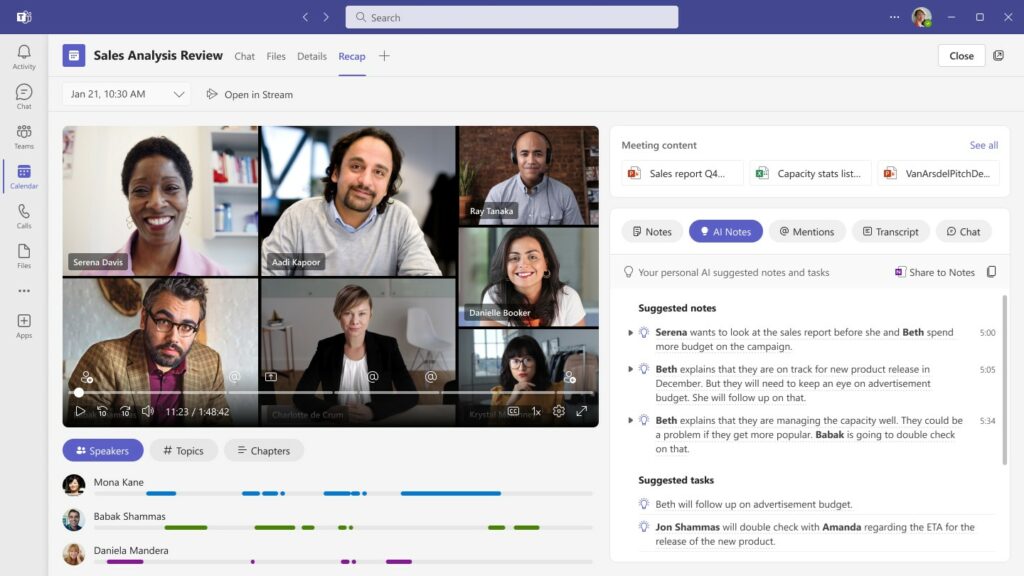
With intelligent recap, you can now save time spent reviewing meeting recordings. AI-generated chapters divide the meeting into sections so it’s easy to pick and choose the content most relevant to you. This is available today for PowerPoint Live meeting recordings. Intelligent recap will automatically generate meeting chapters based on the meeting transcript as well. In addition, there may be particular points in a meeting that you want to revisit. Available today, personalized timeline markers—that only you can see—call out when you joined or left a meeting in the meeting recording, so you can quickly click and listen in on what you missed. Personalized timeline markers will expand to include when your name was mentioned and when a screen was shared.
Soon, these personalized meeting highlights will expand to include speaker timeline markers that show you who spoke during the meeting, when they spoke, and allows you to jump to that moment. Speaker timeline markers are intelligently organized by who you work most closely with, so you’ll never miss feedback shared from your manager in a meeting again.
With intelligent recap, you can focus on the meeting discussion itself and not on capturing notes. In the coming months, you’ll see key points and takeaways after the meeting, with AI-generated notes automatically created and powered by GPT. Follow-up is easy with AI-generated tasks and action items automatically suggested for you.
AI-generated chapters for PowerPoint Live and personalized timeline markers for when you leave and join a meeting are available today. The additional intelligent recap capabilities shared here will be available in the second quarter of 2023.
AI is also here to help with some of the toughest collaboration challenges—working with people who natively speak different languages. Anyone can turn on live captions in Teams and see real-time captions in the spoken language. But if meeting participants speak different languages, organizations often spend thousands of dollars for additional real-time meeting translation services. With live translations (for captions) now available in Teams Premium, you get AI-powered real-time translations from 40 spoken languages. Meeting participants can read captions in their own language, saving money and making meetings more productive and effortless. Only the meeting organizer needs to have Teams Premium for all meeting attendees to enjoy live translations.
